





March 1, 2021
What is CNC Milling?
CNC (Computer Numerical Control) technology has been around for many years (1950's). Milling machines in fact, date back to the 19th century and - the Industrial Revolution.. It's clear that while not new - there is confusion around what CNC milling is and, how it works.
Here is a quick-guide to the basics about CNC milling, the technology behind it and more importantly, what it can do for you.
Is all milling - machining?
Yes. Machining is a mechanical, subtractive process. Basically, this means the removal of material from a work-piece through physical means (screws, bits, metal on metal etc). While this process is not new - and - the two primary means of mechanical machining are mills and lathes, they both remove material - mechanically.
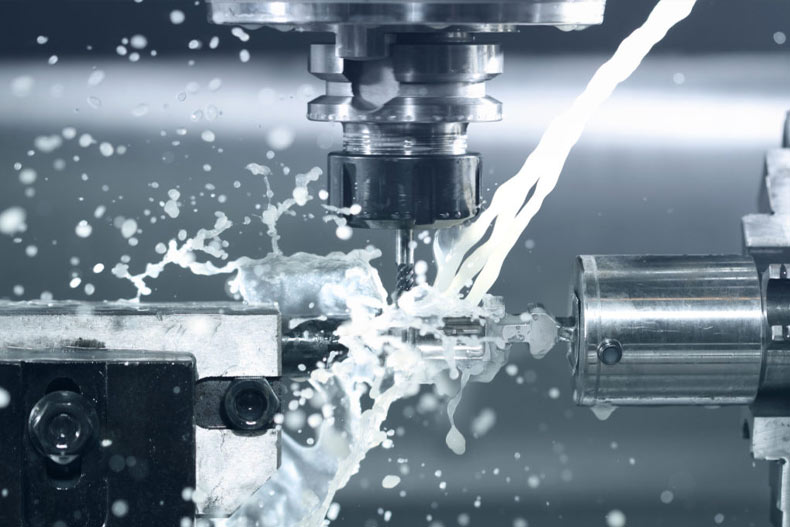
There is of course, a difference between mills and lathes. Mills use a rotating device (milling cutter) to either cut or drill away material. The cutter spins at a high rate of speed while the work-piece is fixed. Depending on the type / configuration of the mill - either the work-piece or the cutter will move slowly to feed the work-piece through the machine.
Lathes are the opposite whereby the work-piece rotates at a high rate of speed while the cutter slowly passes along the part to remove material.
Is all CNC - milling?
No. CNC refers to a technology, not a specific process. While this technology can be applied to mills and lathes as part of the machining process - CNC can also be used with Electronic Discharge Machines (EDM), water jet cutters, 3D printers and numerous other machine types.
That's why it is good to quantify what someone means when they refer to CNC machining. Are they referring to a wide range of CNC-equipped machinery or even the general idea of industrial automation? Or do they mean a CNC lathe or milling machine?
Mills can be vertical - and - horizontal?
Yes. The two most common mill-types are vertical and horizontal...referring to the axis of movement for the mills cutter. Both mill-types appear somewhat similar at first glance - a table for mounting the work-piece, an arm extending out over the table and, the mill cutter mounted beneath the arm.
Taking a closer look however, the differences become apparent:
• Horizontal Mill: The cutter rests on an arbor (a bar stretching between the body of the mill and the downward arm). Basically, the cutter moves back and forth above and parallel to the surface of the workbench beneath. With horizontal mills, the workbench itself is what moves along an X, Y and Z-axis.
• Vertical Mill: While the appearance is similar - there's no arbor. The arm ends in a downward oriented cutter or drill. In this case, it's the cutting head that moves along the X and Y-axis, allowing it to be slowly drilled into the work-piece - or adjusted more slowly as the work-piece is fed through beneath it.
Each machine-type brings a different set of advantages. Vertical mills tend to be smaller and less expensive and, slightly easier to use. Horizontal mills are better suited for larger-scale industrial settings and can be quite large (milling heavy machinery etc).
Can CNC improve existing machine capabilities?
No. Making a simple vertical milling machine CNC-capable does not automatically provide a new range of motion, extra axis of movement or more speed / power.
CNC does provide:
•Precision: Manually operated milling machines rarely provide the same level of precision that a CNC machine provides. CNC technology allows cutting tools to be programmed to extremely precise allowances. More precise cuts deliver cleaner, better quality parts - much more efficiently. Additional benefits include less waste, fewer defective parts and a much more streamlined process in general.
•Automation: CNC machines today use a computer interface to program a set of operations. Skilled operators trained in a CAD (computer assisted design) program or able to program in directly in g-code (CNC language) can design a program, enter it and - let the machine take it from there. There is little need for moment by moment supervision except of course - where troubleshooting is required.
CNC allows a single operator to oversee multiple machines at once. It also allows a single operator to develop a program to produce tens of thousands of identical parts.
Are more axis - better?
Depends. Most milling machines operate with 3-axis of movement (X, Y and Z).Typical vertical mills operate with the Y and Z axis being the movement of the workbench with the X-axis (up and down) being provided by the cutting tool.
5-Axis CNC machines allow an even greater range of movement. The work-pieces can be flipped - providing an A and B axis - all without ever being adjusted on the workbench.
These advanced 5-axis CNC milling machines cost a lot more than 3-axis machines but, they allow for incredibly complex operations to be undertaken in a one go, all without human involvement.
This information barely scratches the surface when learning about CNC machines (how to program, how the CAD programs work, material-types etc). But, hopefully it will provide a bit of guidance when trying to determine if CNC machining is what you need.
Don't be afraid to ask questions regardless of your experience level. Fermer Precision has experienced applications engineers who can provide advice on design modifications and materials to improve the manufacturability of your parts and reduce part costs. Upload your drawings today at www.fermerprecision.com for a cost estimate, lead time and general advice if requested.